Border City
Reggio Calabria,
threshold of the Mediterranean
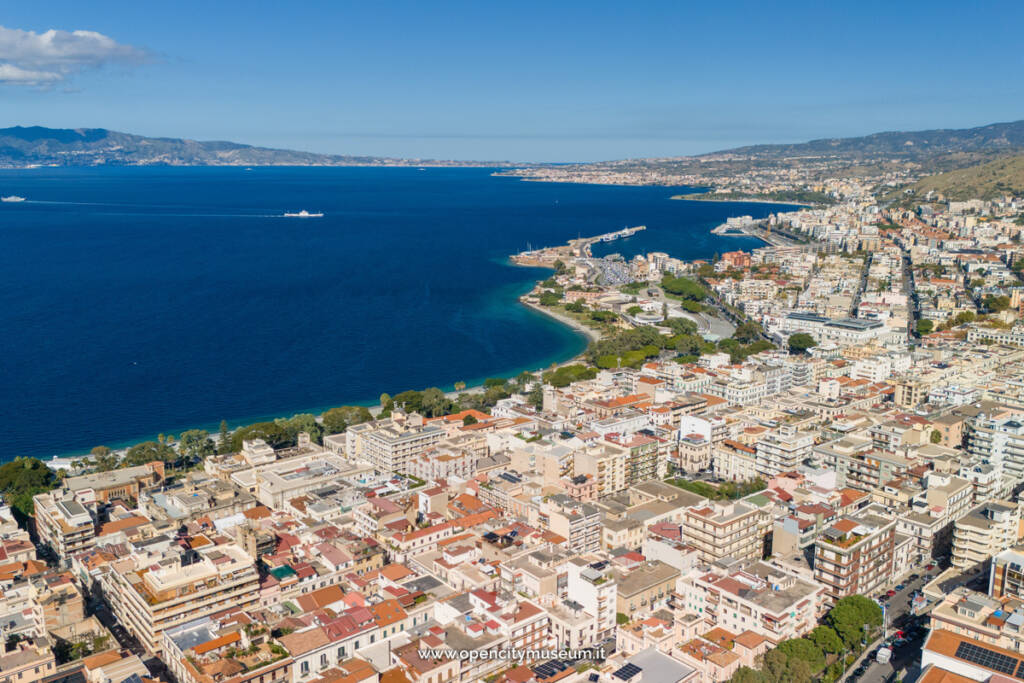
Reggio Calabria is a city born from the sea and for the sea. A meeting point between East and West, it has welcomed over the centuries peoples, cultures, and different faiths. Greeks, Romans, Byzantines, Arabs, Normans, Swabians, Angevins, Aragonese: each has left a trace, a word, an architectural or spiritual sign. The sea of the Strait, with its changing light, does not separate but unites: it is a route of exchange and knowledge. Here different languages were spoken, yet people understood each other through a glance, through the gesture of hospitality. The city, rebuilt several times after earthquakes, has always found in diversity its own strength. Today, as yesterday, Reggio continues to be a gateway to the Mediterranean: a place where history dialogues with the present and where coexistence is a founding value.
The stratification of faith
From Greek liturgy to Latin worship
The spirituality of Reggio Calabria is the child of many traditions.
During the Byzantine rule, the city lived centuries of profound Eastern religiosity, testified by mosaics, icons, and the liturgy in Ancient Greek.
With the arrival of the Normans and the subsequent Latinization, the two souls – the Greek one and the Latin one – learned to live together, to merge, to influence each other.
The church of the Ottimati, with its architectural stratifications, still today tells of this double belonging. The prayers, the chants, and the popular processions are fragments of the same religious identity: that of a city that learned to pray in multiple voices.
It is this coexistence among rites, symbols, and forms of worship that makes the faith of Reggio unique, a faithful reflection of the Mediterranean.
The Jewish Community
Reggio, city of dialogue and exchange
Since the Middle Ages, Reggio Calabria hosted a flourishing Jewish community devoted to trade, craftsmanship, and study. The ancient Giudecca, the quarter in which they lived, was located outside the city walls to the north of the ancient settlement. Here stood workshops, a Jewish school, and the synagogue.
The Jews had an important economic role, and with them there was also remarkable cultural growth—just think that in Reggio the Commentary on the Pentateuch by Rabbi Rashi was printed, the oldest Hebrew manuscript with a certain date: February 1475.
The Jewish presence favored cultural exchanges, giving life to an open society in which knowledge circulated like a precious coin. Alongside them, merchants and sailors from the Arab world brought spices, fabrics, and scientific knowledge to the city. Reggio thus became a small capital of the Mediterranean, where trade was also culture and diversity an opportunity for mutual enrichment.
The cult of Saint Paul and popular devotion
A legend that spans generations
Tradition narrates that Saint Paul landed in Reggio Calabria during his journey to Rome in the year 61 AD, and he was given the possibility to speak to the crowd as long as a candle placed on a column continued to burn. Miraculously, after the candle was consumed, the column itself began to burn, and thus Saint Paul’s preaching lasted until the following morning, succeeding in evangelizing the people of Reggio.
From this episode, passed down through the centuries, one of the most deeply rooted devotions of the city is born, and Saint Paul is considered the founder of the Reggio Church and father of the faith of the Christians of Calabria. Alongside this cult, certainly to be remembered is that dedicated to Our Lady of Consolation (Madonna della Consolazione), patroness of the city, fervently loved by all Reggio’s inhabitants, whose devotion has ancient roots. The first known celebration of the feast dates back to 21 November 1592, when Reggio was protected by the Virgin Mary from the plague that struck the city.
Over the centuries the solemn celebrations have followed one another with the same intense participation, becoming an integral part of the cultural heritage of the people of Reggio.
These feasts, between faith and popular identity, testify to how religion in Reggio is lived as a collective experience, capable of uniting people of different origins and cultures under the same sky.
The City that unites
The multicultural city of the present
Today Reggio Calabria continues to be a crossroads of spirituality. In its streets live and pray together Catholics, Orthodox, Protestants, Muslims, and communities of other religions coming from all over the world.
The presence of new migrant communities from the Middle East, Africa, and Eastern Europe has given new voice to the universal vocation of the city.
The various places of worship coexist in mutual respect, offering spaces for dialogue and solidarity.
Interreligiosity is today a concrete form of citizenship, a common language that unites in diversity. Reggio is an example of how coexistence among different faiths is not utopia, but a living heritage of the Mediterranean.
The welcoming city
Hospitality. Coexistence. Peace.
Reggio Calabria has always welcomed those who arrive from the sea. After every earthquake, every war, every migration, the city has started again by opening itself to others.
Its people have learned that identity is not defended by closing off, but renewed through encounter and listening.
Today the modern Reggio—solidary, intercultural, Mediterranean—is the result of centuries of contaminations. Its squares, its neighborhoods, and its religious and popular festivals are still community spaces where the “we” prevails over the “I.”
This museum is testimony to that. A place that does not exhibit only objects but tells relationships. Because the true soul of Reggio is made of encounters among peoples, religions, and cultures. And every visitor who enters here becomes part of this endless dialogue.