
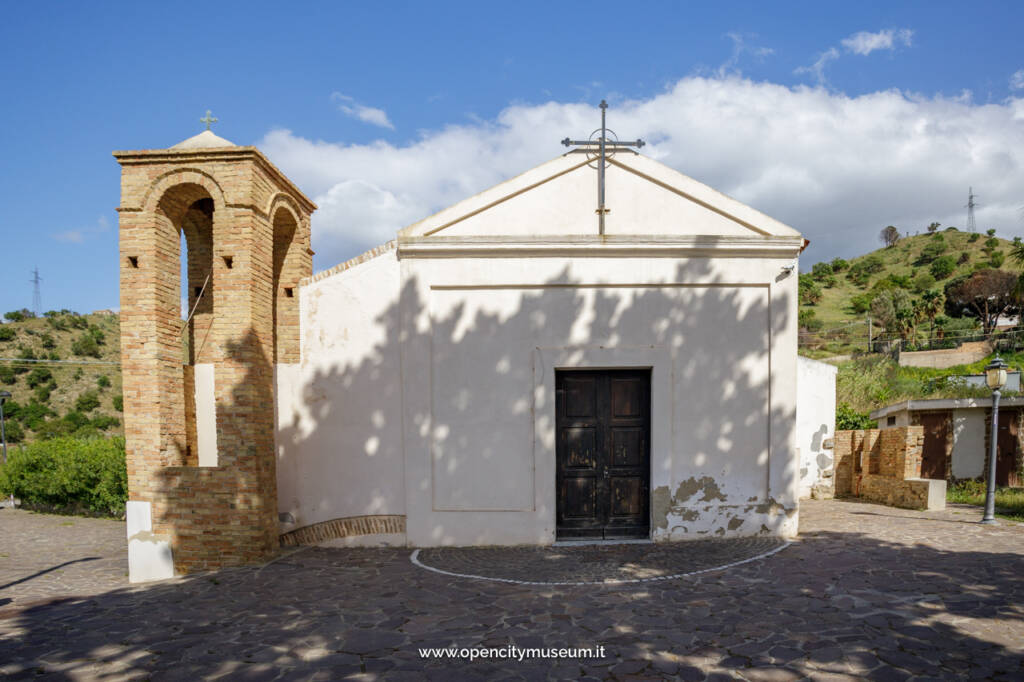
Chiesa di Sant’Antonio Abate di Archi
In the upper part of the Archi district, where the city of Reggio Calabria opens toward the north, rises the church of Saint Anthony the Abbot, whose devotion has roots in the first centuries of Christianity, when the Egyptian saint became a model of ascetic life and a symbol of the inner struggle against the temptations of the world. His feast, celebrated on January 17, is still today linked to the rite of votive bonfires and the blessing of animals, ancient practices that unite faith and agriculture, spirituality and everyday life.
The church represents a precious example of medieval architecture; its construction, in fact, dates back to the 12th century, even if the period of greatest activity is to be placed between the 13th and 14th centuries. The building, in its first construction phase, appeared with three naves and without a transept, with pillars and a tripartite apse and, from an architectural point of view, was an expression of the Basilian-Norman architectural tradition, presenting both eastern features such as the absence of the transept and the triapsidal solution, and western features as shown by the longitudinal development with three naves.
Over time, the church was subjected to various adversities, from Turkish raids to earthquakes, which damaged the structure and made several restoration interventions necessary, which gradually brought substantial modifications.
In the 17th century, the northern wall was rebuilt, the arches of the central nave were closed, while the northern nave was transformed into a sacristy. In the 18th century, the floor level was raised and two crypts with barrel vaults were built, whose walls featured niches for the deposition of the deceased. In the 19th century, the roof and the façade walls were rebuilt, and in the 20th century the bell tower was erected.
Today the religious building appears composed of four structural bodies: a central nave with an almost rectangular floor plan, a left side nave, a right side nave in which the sacristy has been created, and the bell tower. Inside are: the basin in carved marble of a holy water font dating back to the 17th century and a statue of Saint Anthony the Abbot from the 20th century, in carved and painted wood.