
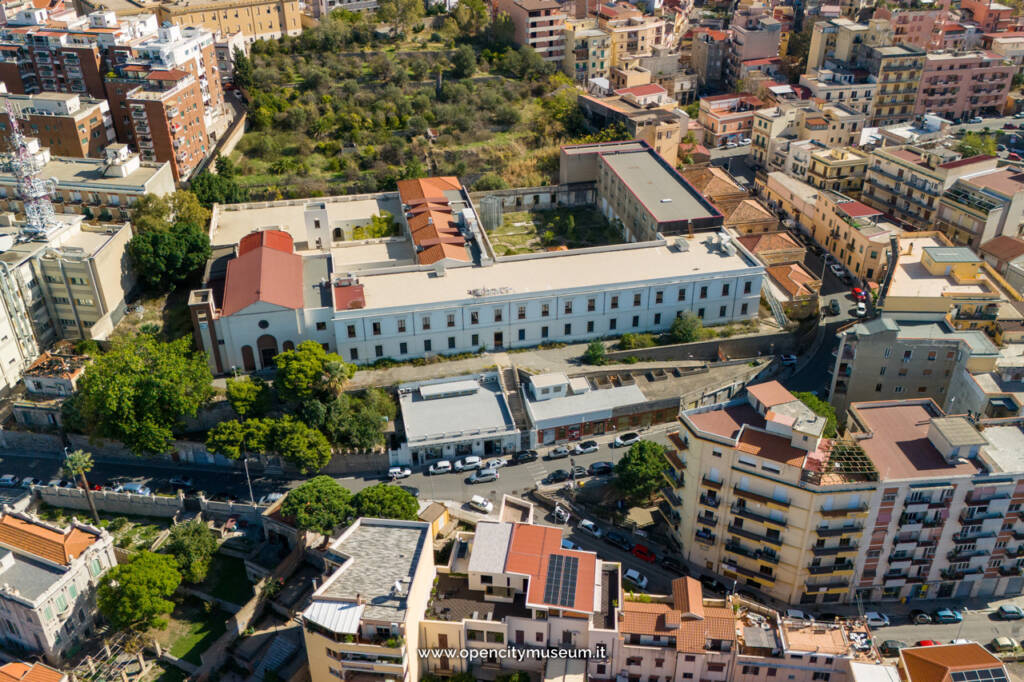
Ex Monastero della Consolazione
The history of the Monastery of the Visitation is closely linked to the Musitano family and in particular to the three sisters Angela, Flavia, and Virginia who, having matured their vocation to contemplative life, decided to consecrate themselves “to the service of God in silence and solitude” and, with the guidance of Monsignor Stefano Morabito, later bishop of Bova, chose to join the Order founded by Saint Francis de Sales: the Visitation of Holy Mary.
The religious community, which in the meantime had grown to twelve Sisters, settled in the Musitano family home, a building overlooking Largo San Silvestro near the current Piazza Italia. It was November 11th, 1754. However, it was necessary to wait until 1840 to obtain official recognition of the community by the Order, after having overcome various vicissitudes: earthquakes, persecutions, and political troubles.
The original place of worship was destroyed by the 1783 earthquake, and it was Ferdinand IV who ordered its reconstruction. The structure built and enriched by additions from the early 19th century extended along the front of Via San Francesco de Sales. As time passed, the area became increasingly frequented and no longer suitable to guarantee the necessary privacy for a religious community dedicated to enclosure, and so, in the second half of the 19th century, procedures began for the construction of a new site. The chosen location, on Via Reggio Campi, was on the upper part of the city, and the work carried out had a great urban and architectural impact.
Today this imposing structure has undergone an important redevelopment intervention to house an articulated museum and exhibition complex. The current monastery is instead located at the Campi di San Nicola di Ortì, on a hill from which one can take in the entire city of Reggio Calabria at a glance.
The construction period of the first sacred building dates back to the 6th century, when Reggio was Byzantine. In the 10th century it was destroyed by the Saracens. In 1060, with the arrival of the Normans, the Church of Reggio returned under the jurisdiction of the Roman pontiff, and the cathedral was built with three naves, a semicircular apse, and two lateral apses.
Turkish incursions, however, continued, and the church was once again destroyed. It was Archbishop Gaspare Del Fosso who took charge of its reconstruction, consecrating it in 1580. In 1594 it was again damaged by the Turks, and it was Archbishop Annibale D’Afflitto who restored it and reopened it for worship in 1599.
Further reconstructions followed in the next century, up until 1740, when the basilica was reinforced and embellished at the will of Mons. Damiano Polou. The earthquake of 1783 seriously damaged the basilica, which was rebuilt in 1791 and opened for worship in 1804.
In 1894 a new earthquake damaged it, and finally the devastating earthquake of December 1908 caused further damage to the structure. The façade, the bell tower, and the upper order were damaged, and the roof of the central nave collapsed, although several polychrome altars, Jerace’s pulpit, and the Chapel of the Blessed Sacrament remained intact.
The decision was to completely rebuild the basilica, which was constructed in an area slightly further south than the previous one, so as to place it in a regular position with respect to the new city layout. The first stone was laid on July 15, 1917, and construction works, based on the design of Father Carmelo Angiolini, were completed in 1928. The Cathedral was inaugurated and consecrated for worship on September 2 of that year, coinciding with the First Regional Eucharistic Congress, in the presence of all the bishops of Calabria.
The Cathedral, dedicated to Mary Most Holy Assumed into Heaven, features a Neo-Romanesque style. It stands elevated above the square in front, Piazza Duomo, to which it is connected by a wide staircase on which are placed the two statues of Saint Paul and Saint Stephen of Nicea, both works by the sculptor Francesco Jerace.
The façade is divided into three sections defined by four small towers and features three bronze portals installed in 1988: the central one, a work by sculptor Luigi Venturini, is dedicated to Mary Most Holy Assumed into Heaven; the one on the left, by Biagio Poidimani, is dedicated to Our Lady of Consolation; the one on the right, by Nunzio Bibbò, is decorated with scenes related to the Apostolate of Saint Paul.
The interior, wide and bright thanks to the presence of large polychrome stained-glass windows, has three naves intersected by three transepts and ends with a raised presbytery area enclosed by a polygonal apse. The ceiling features exposed trusses with polychrome wooden coffers. The fine pictorial decorations of the walls, the transepts, the vaults, and the apses are the work of the Roman painter Eugenio Cisterna.
Along each of the side naves open four chapels; two more flank the presbytery, and at the end of the left nave opens the large Chapel of the Blessed Sacrament from 1539, made of inlaid polychrome marbles—a rare example of Baroque in Calabria—declared a National Monument by President Giuseppe Saragat.
The Cathedral houses valuable works of art that escaped the dramatic events that have affected the building over the centuries. Among the many present, we recall: the Pulpit and the Medallion by Francesco Jerace, an 18th-century full-figure wooden Crucifix, two ambos and two holy-water fonts by Concesso Barca, 19th-century paintings in the presbytery chapels, two 17th-century marble shrines from the ancient Cathedral, and a baptismal font created in 1818 by the Neapolitan silversmith Francesco Auria.