
Reggio Calabria
A thousand-year history
of resilience and beauty
Reggio Calabria, crossroads of the Mediterranean since its origins, rises on the coasts of the southernmost tip of the Italian peninsula, situated between the slopes of the Aspromonte and the eastern shore of the Strait of Messina.
With a thousand-year history that intertwines with ancient legends and fascinating realities, Reggio Calabria represents the tenacity and attachment of a people to their city which, although devastated over time by earthquakes that razed it to the ground, has been able to rise again from its ashes.
The origins and the myth
To recall the foundation of Reggio Calabria, one must begin long before the Greeks. The Chalcidian and Messenian colonists, who arrived only in the 8th century B.C., found a territory already full of memories and legends. The city, so to speak, already had a mythical past.
According to the most ancient tradition, it was Aeolus, king of Lipari and god of the winds, who founded a city called Erythrà, whose name referred to the daughter of Atlas, one of the guardians of the Garden of the Hesperides, which the Greeks imagined right here, on the Calabrian coasts.
The true founder, however, would have been Giocastus, son of Aeolus. It was he who placed the “city of the king” near the river Apsia, the present-day Calopinace, which at the time formed a small natural harbor.
Another myth takes us to the figure of Orestes, son of Agamemnon, who—seeking purification after the murder of his mother Clytemnestra—arrived in the territory of Reggio accompanied by his friend Pylades and by his sister Iphigenia, priestess of Artemis Tauropolos, whose statue she carried hidden in a bundle of wood. Thus was founded a temple dedicated to Artemis Fascelis, and in honor of this goddess festivals were celebrated at least until the arrival of Saint Paul in Reggio.
Finally, when the oracle of Delphi had to indicate to the Chalcidian colonists where to found the new city, it designated precisely the Apsia, the sacred river of Artemis. It was there that the Greeks drove out the Sicels, who lived on the right bank of the present-day Calopinace, and chose to build the city of Rhegion.
The Greek period
Founded towards the middle of the 8th century B.C. (around 730 B.C.) by Chalcidian and Messenian peoples, ancient Rhegion is one of the oldest Greek colonies in southern Italy. According to the historian Diodorus Siculus, it was the oracle of Delphi that indicated the place where to found the new city:
“Where Apsias, the most sacred of rivers, flows into the sea, where, as you disembark, a female joins with a male, there found a city; the god grants you the Ausonian land.”
The city therefore arose at the mouth of the river Apsias (today’s Calopinace stream) near the promontory of Punta Calamizzi, at the point where the colonists saw a vine entwined around a wild fig tree.
Rhegion, a rich and powerful city, extended its dominion over a vast territory that on the Ionian side reached the border with Locri south of Cape Spartivento, and on the Tyrrhenian side reached as far as the river Metauro.
Its period of greatest splendor goes from the 6th to the 5th century B.C.: the flourishing economy was based mainly on the harbor; in fact, because of its strategic position, Rhegion was the crossroads of maritime routes and commercial traffic.
It was also a period of great artistic and cultural prestige thanks to its schools of sculpture and poetry, in which artists such as Pythagoras of Reggio, Clearcus, and Ibycus were trained.
An ally of Athens in the Peloponnesian War, it went to war against Locri Epizephyrii and Syracuse; it was captured by the Syracusans of Dionysius I in 386 B.C. and subjected to the power of the Sicilian city.
The Roman period
In the 3rd century B.C. it was an ally of Rome and adopted its customs while preserving the use of the Greek language. The Romans made it an important naval base during the First Punic War and defended it from attacks by the Carthaginians led by Hannibal.
A federated city since 270 B.C. with the name Rhegium, in 89 B.C. it was elevated to municipium, obtaining the freedom to govern itself with its own laws.
In the Augustan age it took the name Rhegium Julium and was among the most important and flourishing centers of southern Italy, being also the seat of the governor of the province of “Lucania and Bruttium.”
It was the terminal point of the Via Capua–Rhegium, which connected it to Capua in Campania and crossed the entire southern Tyrrhenian side of the peninsula.
In this period the city was enriched with sumptuous architecture and with public and private bath complexes.
The city embraced the Christian faith when Saint Paul, traveling from Malta to Rome, stopped there, as testified in the Acts of the Apostles (XXVIII, 13), and consecrated as its first bishop his disciple Stephen of Nicea.
The barbarian invasions and the Byzantine period
The city was sacked and destroyed by Alaric in 410, and with the end of the Western Roman Empire it was several times threatened during the period of the barbarian invasions.
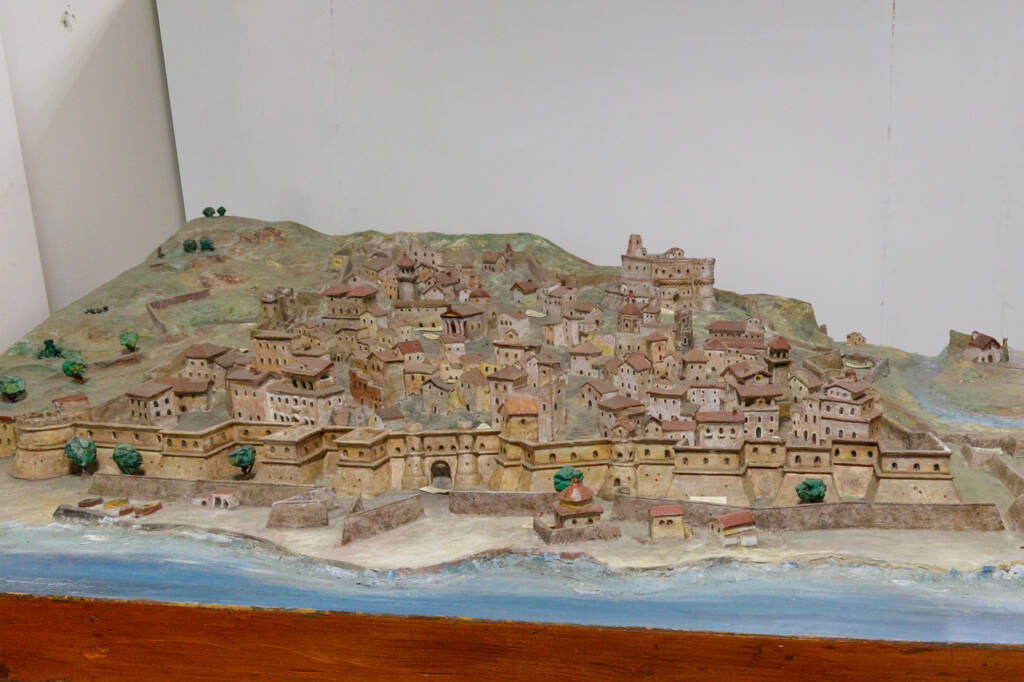
Under Emperor Justinian, it was conquered by the army led by Belisarius in 536 and was equipped with walls and fortifications.
Five centuries of stability followed under the Byzantine Empire, which also brought economic well-being, and Reggio became the stronghold of Greek culture in Italy.
At the beginning of the 900s the city was conquered by the Arabs and then retaken in 909 by the Byzantines, who chose it as the “Capital of the Duchy of Calabria,” and to defend it from Arab raids they enlarged the castle and erected inland fortifications called “motte.”
Middle Ages and the Norman–Angevin–Aragonese period
In 1060 the Normans took Reggio from the Byzantines; Robert Guiscard named himself Duke of Calabria and brought the city into the Latin cultural sphere and—while still allowing the Orthodox liturgy—imposed the Catholic hierarchy.
Subsequently the city came under the control of the Spanish dynasties of the Angevins and the Aragonese.
In 1282, during the Sicilian Vespers, it sided with Messina and other cities of eastern Sicily in the anti-Angevin revolt, but without success, so that Angevin rule continued for more than a century.
The 16th century
The 16th century is marked by Spanish domination, but above all it is the period in which Reggio suffered numerous incursions by Turkish pirates which, in addition to disrupting trade and various productions, also weakened it politically.
To protect the city, a defensive wall and several towers were built. The gates of San Filippo, Mesa, Dogana, and Melfitana were opened.
Moreover, in 1562 a strong earthquake struck the urban center and caused the sinking of the promontory of Punta Calamizzi, resulting in the loss of the port.
The 17th and 18th centuries
In the seventeenth century began the cultivation of bergamot, which together with silkworm breeding constituted the most important productive activities.
In this period Reggio returned to its splendor with the construction of churches and sumptuous buildings.
In the eighteenth century the city came under the government of the Bourbons and experienced a period of demographic growth and economic prosperity.
However, it was a century plagued by very serious events: a flood of the Calopinace in 1742, then epidemics such as the plague of 1743 which killed thousands of people, and finally the disastrous earthquake of 1783 after which the city was rebuilt according to the plan of engineer Giovambattista Mori.
The new urban layout led to the demolition of many historic buildings and gave the city an entirely new look, abandoning forever the old medieval structure.
The 19th century
In 1806 the French occupied the city, which was elevated to a duchy. The French government, which remained in charge until 1815, introduced important reforms in various sectors: from administration to economy, from education to relations with the Church.
Following the Napoleonic defeat, the period of the Restoration opened, returning the deposed dynasties to the throne. Thus Reggio returned under Bourbon rule, but liberal ideas and national aspirations had taken hold even in the city, placing it at the center of events that foreshadowed the uprisings of 1848.
In 1847 the brothers Domenico and Giannandrea Romeo attempted to seize the city from the Bourbons but were killed.
In 1860, after conquering Sicily, Giuseppe Garibaldi landed on the beach of Melito Porto Salvo and from there headed to Reggio, where on 21 August, in Piazza Duomo, an epic battle took place between the Garibaldini and the Bourbon army, at the end of which Garibaldi captured the city.
The 20th century
On 28 December 1908 Reggio was devastated by one of the most catastrophic events of this century, which also struck Messina: an earthquake reaching magnitude 7.1 followed by a tsunami that struck the city with very high waves, destroying, devastating, and killing. Nearly half of the population of Messina and about one-third of that of Reggio lost their lives.
The reconstruction of the city was entrusted to engineer De Nava who, in his very rigorous urban plan, designed a city with a square layout and with the creation of straight arteries parallel to the coast.
To that period dates the demolition of part of the castle, of which only the two towers still existing were saved, and that of the Cathedral which—although not severely damaged—was demolished and rebuilt from scratch.
In 1927, during the fascist period, 14 formerly autonomous municipalities were annexed to the city: Campo Calabro, Cannitello, Cataforio, Catona, Fiumara, Gallico, Gallina, Pellaro, Podargoni, Rosalì, Salice Calabro, Sambatello, Villa San Giovanni and Villa San Giuseppe.
It was the “Greater Reggio” project which led to a notable expansion of the municipal territory and to an increase of the urban population, which exceeded 100,000 inhabitants.
During the Second World War, Reggio was bombed in May 1943 by the Allied forces, and the districts of Santa Caterina, Arangea, Tremulini, and Sbarre were razed to the ground. In the same year, on 3 September, it was occupied by the troops of the Anglo-American Eighth Army, which established a new municipal administration there.
The “Reggio Riots”
In the early seventies (July 1970 – February 1971) Reggio Calabria was shaken by violent street riots due to the claim to the status of regional capital.
It was a real urban guerrilla that transformed the city into a battlefield with hundreds of wounded, five dead, and enormous damage.
The cessation of the disorders was reached through a compromise that provided for the division of the institutional seats: Catanzaro was assigned the title of capital and the seat of the Regional Government, while the seat of the Regional Council was granted to Reggio Calabria.
The “Springtime of Reggio”
Between the seventies and eighties the city went through a dark twenty-year period that favored the spread of organized crime and urban decay, but starting from the early nineties began a period of renewal—the so-called “Springtime of Reggio”—initiated by the then mayor Italo Falcomatà, which enabled the city to rediscover its identity and to support social and economic recovery.
The city was at the center of an urban and architectural transformation geared toward modernity and innovation. One of the most important works was the completion of the waterfront.